The example bill
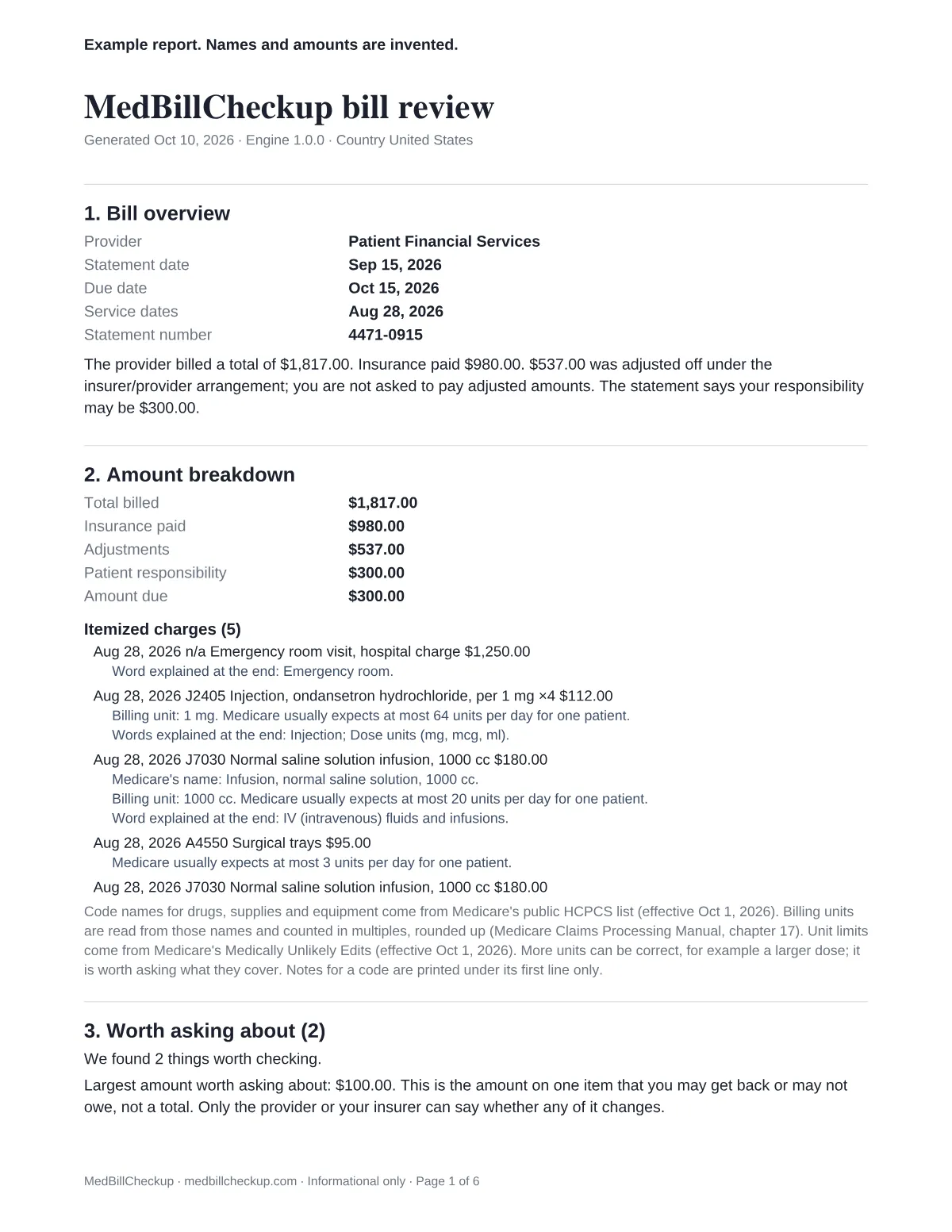
An emergency room visit: 5 charges, $1,817.00 in total, and $300.00 left for the patient after insurance. The patient says they have already paid $400.00.
What the free check shows
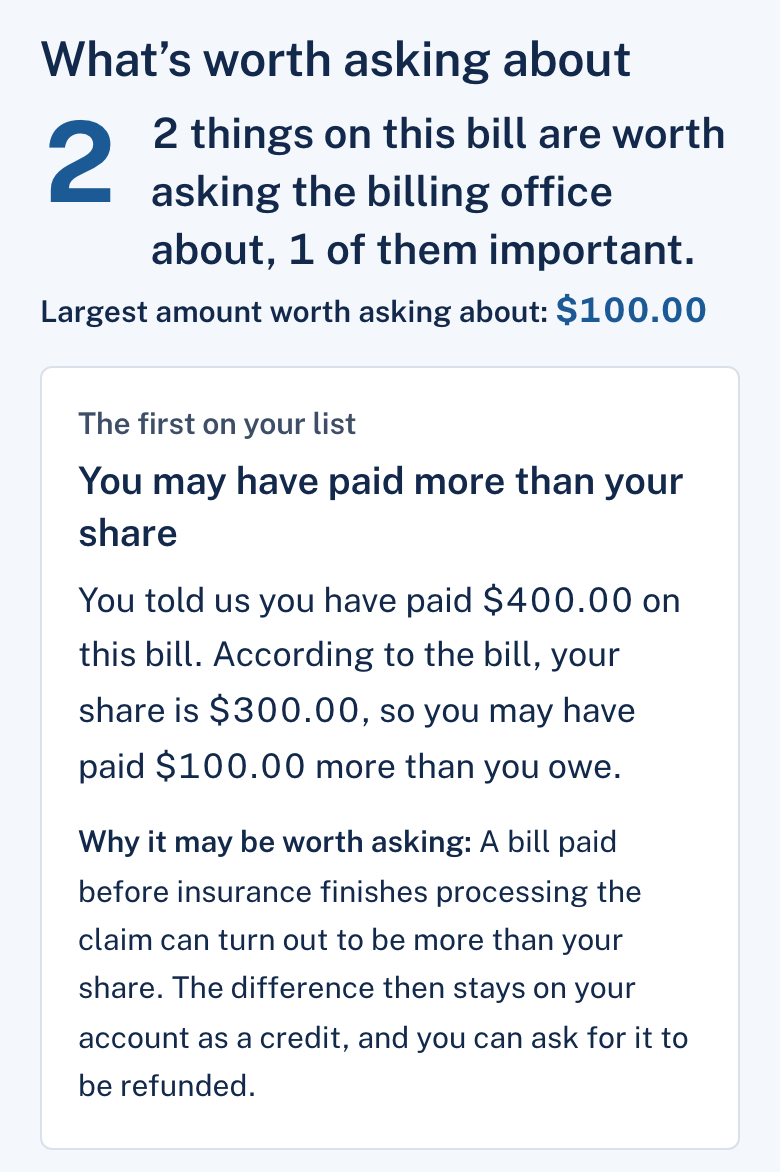
2 things worth asking about, 1 of them important, and $100.00 as the largest amount worth asking about: the amount on one item that the patient may get back or may not owe, worked out from their answer and the bill (here, the payment above their share). It also names the first item, says why it may be worth asking, and shows how the letter starts. You see this much for your own bill before paying anything.
What the full list adds
Every item, why it is worth asking about and the question to ask: here, a payment that may be above the patient’s share, and a saline infusion that appears twice on the same day. On screen, the first step it offers is a letter to the billing office that you can edit and send. The PDF report is the copy to keep: the same list with each charge explained (Medicare’s name for a drug or supply code, how it is counted, the most units Medicare usually expects, and the billing words on the line), the questions, what to do next, a call guide, a call log, the letter, and a last page that explains the billing words on the bill.
Normal saline solution infusion, 1000 cc (code J7030)
- Medicare’s name: Infusion, normal saline solution, 1000 cc.
- Billing unit: 1000 cc. Medicare usually expects at most 20 units per day for one patient from one provider.
- Word explained at the end: IV (intravenous) fluids and infusions.
Code names for drugs, supplies and equipment come from Medicare’s public HCPCS list (effective October 1, 2026). Billing units are read from those names and counted in multiples, rounded up (Medicare Claims Processing Manual, chapter 17). Unit limits come from Medicare’s Medically Unlikely Edits (effective October 1, 2026). They are per provider and not for inpatient stays; we show the higher of the doctor and hospital outpatient limits. More units can be correct, for example a larger dose, though some limits are firm; it is worth asking what they cover.
Only the provider or the insurer can say whether anything on a real bill changes.
Open the sample report (PDF)Check your own bill
Reading your bill and the free check are free. The full list is $6.99 for one bill, or comes with Pro. The bill file is read on your device and never uploaded.
MedBillCheckup provides informational assistance only. It does not determine whether a charge is medically necessary, fraudulent, illegal, or definitively incorrect, and it is not a substitute for advice from a lawyer, doctor, insurer, or certified medical billing specialist.